
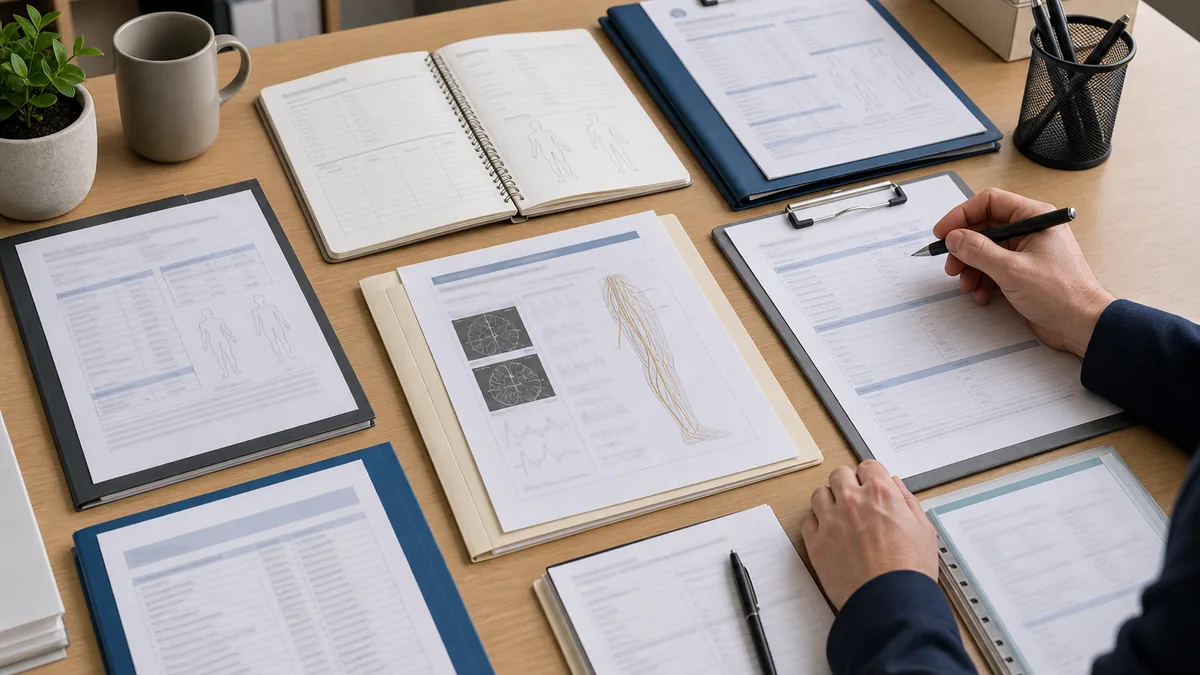
Overview for NSW injured workers
Start with the dispute, not just the diagnosis
May be relevant when
Benefits to check
Legal help is useful when
How this affects your claim in practice
In a complex regional pain syndrome crps claim, the diagnosis is only the starting point. The records should connect contemporaneous findings across sensory, vasomotor, sweating or oedema, and motor or trophic domains and for CRPS type 1, records showing the condition for at least one year and confirmation by more than one examining physician with the worker's practical limits, including tolerance for touch, temperature, footwear, gloves, vibration and repeated limb use and reliable standing, walking, grip, dexterity or protective sensation depending on the affected extremity. If the insurer disputes whether the NSW diagnostic criteria are met across the required clinical domains, the response should address that reason directly.
Related claim pathways
Other claims that may need to be considered
A work injury claim is often the first issue, but some facts can raise a separate insurance or injury pathway. These links are included only where the overlap may genuinely matter.
Long-term inability to return to work
If you are unlikely to return to suitable work long-term, you may also need to check whether TPD insurance through superannuation is available. TPD is separate from workers compensation.
My TPD ClaimsAssessment source
- NSW Guidelines for the Evaluation of Permanent Impairment, paras 1.8-1.12: NSW Guidelines control the assessment method and AMA5 is used only where adopted and not modified.
- NSW Guidelines para 1.12: AMA5 Chapter 18 pain is excluded; chronic pain is assessed through the underlying diagnosed condition, while CRPS is assessed under the relevant NSW method.
- NSW Guidelines para 1.15: assessment should usually wait until maximum medical improvement, meaning the condition is stable and unlikely to change substantially in the next year.
- NSW Guidelines paras 17.2 and 17.5 and Table 17.1: AMA5 Chapter 18 and AMA5 section 17.2m are not used; the NSW diagnostic criteria determine whether CRPS is rateable.
- NSW Guidelines Chapter 17: CRPS type 1 must have been present for at least one year, be verified by more than one examining physician, satisfy all four symptom and sign domains, and not be better explained by another diagnosis.
- NSW Guidelines Chapter 17: type 1 combines permitted extremity movement and sensory/pain components; type 2 additionally requires objective injury to a specific nerve and may include the permitted motor component.
- NSW Guidelines paras 2.21, 3.35 and 5.7: upper- and lower-extremity CRPS are directed to the NSW Chapter 17 method and converted through the applicable upper- or lower-extremity table.
What injuries or conditions may be assessed?
CRPS may follow fracture, surgery, crush injury, nerve injury or another accepted limb trauma and can affect sensory, vasomotor, sweating or oedema, movement and trophic function.
- CRPS type 1 does not require a confirmed specific nerve lesion. CRPS type 2 requires objective evidence of injury to a specific nerve.
- The condition must be distinguished from ordinary post-injury pain, disuse, isolated nerve loss, infection, vascular disease and any other diagnosis that better explains the signs and symptoms.
Symptoms and findings that matter
NSW Table 17.1 requires continuing disproportionate pain plus at least one reported symptom in each of the sensory, vasomotor, sudomotor or oedema, and motor or trophic domains.
At the impairment evaluation, at least one observed and documented sign must be present in every one of those four domains.
The diagnosis must have been present for at least one year, be verified by more than one examining physician and not be better explained by another diagnosis.
For type 2, the evidence must also identify the injured nerve and clinically consistent sensory and any motor loss.
What investigations are usually relevant
Investigations for complex regional pain syndrome crps may include longitudinal treating and specialist records documenting onset, duration and observations across all four NSW domains and the impairment examination recording side-to-side temperature, colour, swelling or sweating, active joint movement, sensory signs and motor or trophic change. Each result should answer a defined clinical question and be read with the examination, diagnosis and history.
- Evidence from more than one examining physician and reasoning excluding a better alternative diagnosis.
- For type 2, objective evidence of a specific nerve injury and the named-nerve sensory and motor measurements.
How WPI is assessed for this body part
First apply NSW Table 17.1 and the duration, multi-examiner and exclusion requirements. A CRPS label or severe pain does not bypass this diagnostic gateway.
For type 1, rate permitted extremity movement loss and the sensory or pain component selected under the NSW method, combine those extremity values and then convert to WPI.
For type 2, the same sequence may include the permitted named-nerve motor component because a specific nerve injury is required.
Use AMA5 Table 16-3 for upper-extremity conversion or Table 17-3 for lower-extremity conversion. Do not add an AMA5 Chapter 18 pain percentage.
Table and value examples
CRPS type 1 assessment sequence
Permitted movement plus sensory/pain extremity impairment; combine, then convert to WPIThe maximum sensory value is not automatic and the diagnostic requirements must be satisfied first.
Source: NSW Guidelines Chapter 17 and Table 17.1
CRPS type 2 assessment sequence
Permitted movement plus specific-nerve sensory and motor components; combine, then convert to WPIObjective injury to a specific nerve is required and overlapping loss is not rated twice.
Source: NSW Guidelines Chapter 17; AMA5 Tables 16-10a and 16-11a
Worked assessment illustrations
These examples paraphrase the assessment reasoning in the source material. They explain method only and are not predicted outcomes.
Illustration 1
Upper-limb CRPS using the NSW extremity method
Assumed facts: After the NSW diagnostic requirements are met, the assumed examination produces 7% upper-extremity impairment for movement loss and 30% upper-extremity impairment for the permitted sensory component.
Method: The Combined Values Chart combines 30% and 7% to 35% upper-extremity impairment. No additional AMA5 Chapter 18 pain percentage is added.
Illustrative outcome: AMA5 Table 16-3 converts 35% upper-extremity impairment to 21% WPI. Diagnosis, duration and measurable findings must first satisfy the NSW CRPS rules. This paraphrased illustration is not an estimate for any individual claim.
Source: NSW Guidelines paras 1.12, 2.21 and Chapter 17; AMA5 Table 16-3
Illustration 2
Lower-limb CRPS type 2 extremity calculation
Assumed facts: After the NSW CRPS criteria are satisfied, assume 4% LEI for ankle movement, a medial plantar nerve sensory component of 5% LEI and a motor component of 1% LEI.
Method: The permitted lower-extremity components are combined, not simply added. On these assumed values the Combined Values Chart produces 10% LEI after rounding, which then converts through AMA5 Table 17-3.
Illustrative outcome: Ten per cent LEI converts to 4% WPI. No AMA5 Chapter 18 pain percentage is added. This paraphrased illustration is not an estimate for any individual claim.
Source: NSW Guidelines paras 1.12, 3.35 and Chapter 17; AMA5 Tables 16-10, 16-11, 17-3 and 17-37; paraphrased from the supplied AMA5 companion
What usually does not increase WPI
Severe pain alone does not satisfy the NSW CRPS criteria or produce an impairment percentage.
Reported symptoms without an observed sign in every required domain at the assessment do not satisfy Table 17.1.
A diagnosis recorded by only one examiner, a condition present for less than one year or a better alternative diagnosis prevents the CRPS impairment method from being assumed.
Movement, sensory, motor and generic pain values cannot be duplicated, and AMA5 Chapter 18 is excluded.
Evidence checklist
The records for complex regional pain syndrome crps should include records showing at least one year of the condition and verification by more than one examining physician and a diagnostic record addressing reported symptoms and observed signs in all four NSW Table 17.1 domains. They are most useful when the diagnosis, examination and practical restrictions are consistent.
- Reasoning excluding another diagnosis that better explains the presentation.
- Valid upper- or lower-limb movement measurements and, for type 2, the specific-nerve sensory and motor findings.
- A calculation combining only permitted extremity components and excluding AMA5 Chapter 18 pain.
How this injury commonly happens at work
Work-related complex regional pain syndrome crps can arise through CRPS developing after an accepted fracture, crush injury, surgery or prolonged immobilisation and regional symptoms following a documented upper- or lower-limb trauma. The chronology should identify the actual task or event and when symptoms or function changed.
Work-related complex regional pain syndrome crps can arise through CRPS type 2 following an accepted injury to a specific peripheral nerve. The chronology should record the actual task or event and the point at which symptoms or function changed.
Common insurer disputes
For complex regional pain syndrome crps, an insurer may dispute whether the NSW diagnostic criteria are met across the required clinical domains and whether another diagnosis better explains the regional signs. The written decision should be answered with evidence directed to those reasons.
Further disputes about complex regional pain syndrome crps may concern whether type 1 or type 2 applies and, for type 2, whether a specific nerve injury is established and whether an impermissible AMA5 Chapter 18 pain value or overlapping extremity loss has been added. The decision notice should identify which issue is relied on and the evidence said to support it.
Treatment and surgery issues
Depending on the diagnosis and treating opinion, management of complex regional pain syndrome crps may involve pain-specialist and condition-specific medical review where clinically supported and physiotherapy or occupational therapy directed to graded movement, desensitisation and safe function. The request should explain the expected functional benefit and its connection to the accepted injury.
Further management of complex regional pain syndrome crps may involve medication, procedure and rehabilitation review tied to documented response and work restrictions. The request should explain why the proposed step is connected to the accepted injury and what functional improvement is expected.
Weekly payments and work capacity
Capacity evidence for complex regional pain syndrome crps should address tolerance for touch, temperature, footwear, gloves, vibration and repeated limb use and reliable standing, walking, grip, dexterity or protective sensation depending on the affected extremity. Proposed duties must be sustainable for the proposed hours, not merely possible once.
For complex regional pain syndrome crps, capacity evidence should address attendance and task sustainability where flare-ups, medication or treatment affect a full roster. The question is whether those activities can be performed safely, reliably and for the proposed hours—not whether a task can be attempted once.
How NSW Work Injury Claim can help
For complex regional pain syndrome crps, a claim review can help to test the records against each NSW CRPS diagnostic domain and identify whether type 1 or type 2 is alleged and document any specific nerve lesion. The purpose is to identify the precise decision and the evidence needed for the next available step, not to promise an outcome.
For complex regional pain syndrome crps, a claim review can help to check the extremity calculation, conversion and non-duplication steps. The purpose is to identify the precise decision and the evidence needed for the next available step, not to promise an outcome.
Common questions about complex regional pain syndrome crps claims
How can work cause or aggravate complex regional pain syndrome CRPS?
For complex regional pain syndrome CRPS, the relevant work history may include CRPS developing after an accepted fracture, crush injury, surgery or prolonged immobilisation, regional symptoms following a documented upper- or lower-limb trauma, and CRPS type 2 following an accepted injury to a specific peripheral nerve. A claim still depends on the actual chronology and medical evidence. The records should identify what changed, when symptoms began or worsened, and how the diagnosed condition affects the worker's duties.
How is WPI assessed for complex regional pain syndrome CRPS?
For complex regional pain syndrome CRPS, first apply NSW Table 17.1 and the duration, multi-examiner and exclusion requirements. A CRPS label or severe pain does not bypass this diagnostic gateway. NSW Table 17.1 requires continuing disproportionate pain plus at least one reported symptom in each of the sensory, vasomotor, sudomotor or oedema, and motor or trophic domains. The assessor must apply the NSW Guidelines to the accepted, stable condition; the diagnosis or an operation does not by itself determine a percentage.
Which records are most useful for a complex regional pain syndrome CRPS assessment?
A complex regional pain syndrome CRPS assessment commonly needs records showing at least one year of the condition and verification by more than one examining physician, a diagnostic record addressing reported symptoms and observed signs in all four NSW Table 17.1 domains, reasoning excluding another diagnosis that better explains the presentation, and valid upper- or lower-limb movement measurements and, for type 2, the specific-nerve sensory and motor findings. Those records are most useful when they describe the same diagnosis, examination findings, treatment history and practical work restrictions.
What does an insurer commonly dispute about complex regional pain syndrome CRPS?
For complex regional pain syndrome CRPS, common issues include whether the NSW diagnostic criteria are met across the required clinical domains, whether another diagnosis better explains the regional signs, and whether type 1 or type 2 applies and, for type 2, whether a specific nerve injury is established. The response should address the insurer's stated reason with the relevant chronology, clinical findings, investigations and duties evidence rather than relying on the diagnosis alone.
How can complex regional pain syndrome CRPS affect weekly payments and suitable duties?
Capacity evidence for complex regional pain syndrome CRPS may need to address tolerance for touch, temperature, footwear, gloves, vibration and repeated limb use, reliable standing, walking, grip, dexterity or protective sensation depending on the affected extremity, and attendance and task sustainability where flare-ups, medication or treatment affect a full roster. A certificate should describe what the worker can do safely and sustainably. Proposed duties should then be checked against those restrictions and the real demands of the job.
Does complex regional pain syndrome CRPS automatically receive a fixed WPI percentage?
No. For complex regional pain syndrome CRPS, one verified example is crps type 1 assessment sequence: Permitted movement plus sensory/pain extremity impairment; combine, then convert to WPI, under NSW Guidelines Chapter 17 and Table 17.1. That value applies only when its stated criteria are met. Severe pain alone does not satisfy the NSW CRPS criteria or produce an impairment percentage.
Request a calm claim position review
If you have received an insurer decision or you are unsure how your injury evidence fits together, we can help you identify the issue, organise the documents and consider the next step. Where ILARS funding is approved, eligible legal costs and necessary disbursements may be covered.
Related NSW workers compensation guides
- Treatment denied
- Head, brain and neurological WPI assessment
- Traumatic brain injury
- Seizure disorder after neurological injury
- Cranial nerve injury
- Balance and neurological gait disorder
- Peripheral nerve injury
- Neurological bladder, bowel and sexual dysfunction
- Workers compensation claims
- Weekly payments
- Claim denied
- Work capacity decisions
- IME guide
- WPI assessment guide