
What to document in a brain injury claim
- Incident, ambulance, emergency and witness records can clarify the mechanism and early neurological findings.
- GP, specialist and rehabilitation records should describe diagnosis and practical function over time.
- Claim acceptance, treatment, work capacity, weekly payments and WPI are related but legally distinct questions.
A head impact at work does not automatically establish an entitlement. The evidence must satisfy the applicable NSW workers compensation requirements, including causation. See the Workers Compensation Act 1987 (NSW), including sections 4, 9 and 9A.
Records that help explain the injury and its effects
Record the incident mechanism, keep treating evidence that explains functional cognitive limits, and compare any insurer capacity assumption with the work tasks and medical restrictions actually documented.
- Ask treating providers to describe practical task limits (attention span, fatigue, error rate), not just diagnosis labels.
- Keep timeline evidence of failed or partial return-to-work attempts.
- Read each insurer notice for the decision, reasons, supporting material and any review information it contains.
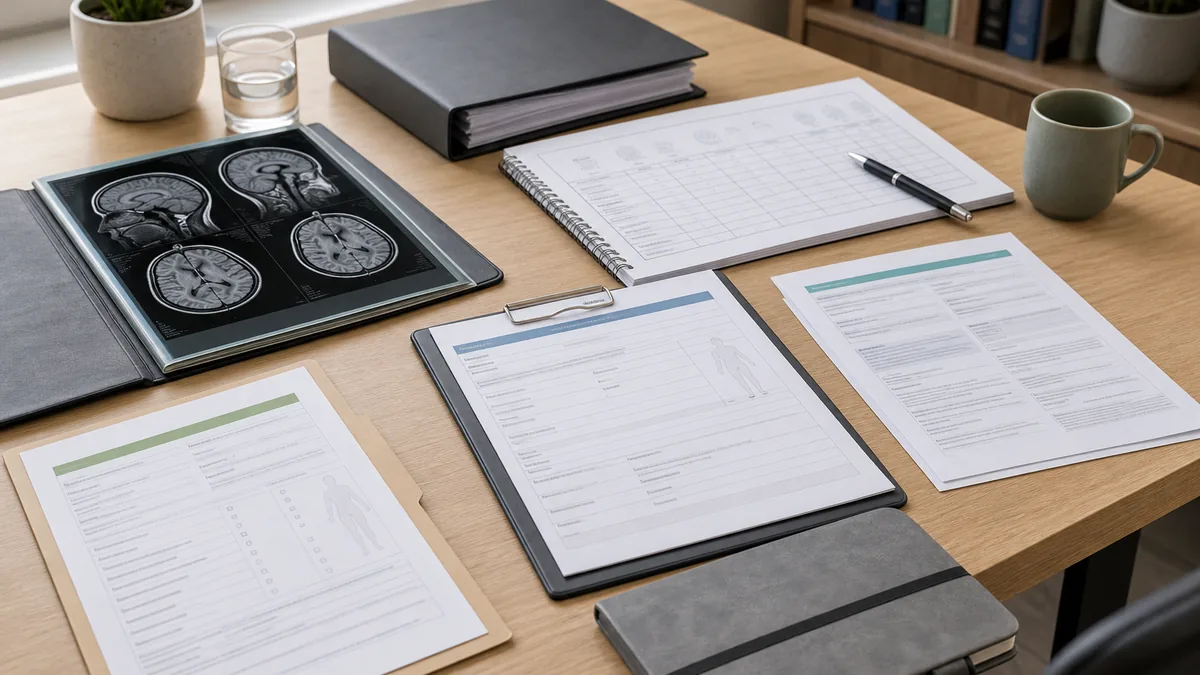
A dated record of hospital findings, cognitive limits, treatment and insurer decisions helps identify the medical and legal questions in dispute.
Why scan results are not the whole assessment
A brain injury claim should not be reduced to the question “Was there visible damage on early scans?” Concussion and other traumatic brain injury can involve cognitive fatigue, concentration difficulty, headache, mood change and reduced work tolerance. Those reports still require clinical assessment, diagnosis and evidence connecting them to the work event; normal imaging neither proves nor disproves every claimed consequence.
If the insurer has shifted focus to suitable employment or reduced earnings assumptions, pair this page with the work-capacity dispute guide and the weekly payments stopped checklist.
What workplace brain injuries can involve
A workplace head injury may involve concussion, post-traumatic amnesia, intracranial bleeding, skull or facial injury, vestibular disturbance, cranial nerve effects, cognitive change or a more severe traumatic brain injury. The medical diagnosis and accepted work injury should be identified rather than treating every headache or concentration complaint as the same condition.
How TBI WPI is assessed in NSW and the source used
NSW Guidelines paragraph 5.9 requires evidence of a severe or high-energy impact and at least one specified indicator before the traumatic brain injury method is used: an abnormal Glasgow Coma Scale score, significant post-traumatic amnesia, or intracranial pathology on CT or MRI. If that gateway is met, the assessment may examine consciousness and awareness, cognition and memory, language and communication, emotional or behavioural change, gait or movement and cranial nerve function. Symptoms alone do not establish a WPI percentage.
NSW paragraph 5.4 also changes the base AMA5 cerebral rule. A supported impairment in consciousness, cognition, communication and neurologically based emotion or behaviour is evaluated separately and then combined, after overlap is removed. This neurological behavioural category is not the same as a primary psychiatric PIRS assessment, and secondary psychiatric impairment is not added to physical or neurological WPI.
Useful material can include ambulance and hospital notes, the initial Glasgow Coma Scale, post-traumatic amnesia records, imaging, neurologist opinion, neuropsychological testing, occupational therapy or functional assessment and consistent evidence about day-to-day and work limitations.
Read the head, brain and neurological WPI assessment guideNSW Guidelines for the Evaluation of Permanent Impairment, nervous-system chapterLegal and assessment sources last reviewed: 21 July 2026.
Worked assessment illustration
Cognitive impairment after a verified TBI
Assume a worker has a qualifying traumatic brain injury and formal assessment records material memory loss together with poorer orientation, judgment, community functioning and personal care. Under AMA5 Tables 13-5 and 13-6, memory is the starting category and the secondary functional findings determine the Clinical Dementia Rating. If the supported pattern produces CDR 2, Table 13-6 places it in Class 3, a 30-49% WPI range; the assessor selects the precise value from the need for supervision and the effect on daily mental function.
This paraphrased example explains the method only. It is not an estimate or predicted outcome. Source: NSW Guidelines paragraphs 5.3-5.9 and AMA5 Tables 13-5 and 13-6, subject to the NSW cerebral combination rule.
Common points of disagreement
1. Symptom records are inconsistent
Small gaps in reporting are used to argue that symptoms resolved. Keep consistent treating records and capacity certificates.
2. Capacity evidence does not address endurance
A report may identify physical ability without adequately explaining concentration, fatigue, reliability or whether performance can be sustained across the proposed hours and duties.
3. Treatment and rehab plans are narrowed
Neuropsychology, allied health, or specialist reviews may be declined as “not necessary” unless recommendations are specific and well-supported.
4. Permanent effects are described too generally
A reliable WPI assessment needs the relevant neurological or cognitive domain and functional loss to be identified, rather than a general statement that symptoms continue.
Evidence checklist
- Emergency/hospital records, incident reports, and witness accounts of the head-impact event.
- Current certificates of capacity and treating GP/specialist letters addressing cognitive restrictions.
- Rehab and neuropsychology records that explain functional limits over time, not just one date.
- Insurer notices about payment cuts, treatment denials, and any IME opinions relied on.
- Wage documents, payroll records, pay slips, rosters, and bank records if PIAWE or reduced earnings are part of the dispute picture.
FAQs
Can I claim workers compensation for concussion or mild TBI in NSW?
A concussion or mild TBI may be compensable where the evidence establishes a work injury and the applicable employment-connection and causation requirements. Normal imaging does not decide that question by itself. The mechanism, records close to the event, diagnosis and medical opinion all need to be considered.
What issues can arise in a brain injury claim?
A dispute may concern whether the diagnosed condition resulted from the work event, whether symptoms have resolved, current work capacity, or whether proposed treatment is reasonably necessary. The insurer’s written reasons should be answered with evidence directed to the issue actually raised.
What evidence carries the most weight when symptoms are "invisible"?
There is no single decisive record. Consistent treating notes, neuropsychological findings interpreted in clinical context, certificates of capacity, rehabilitation records and documented return-to-work attempts can help explain cognitive endurance and function over time.
How quickly should I act after a payment reduction or section 78 notice?
Check the decision and any review time limit promptly. Collect treating evidence, timeline notes and the documents relied on by the insurer so the actual capacity or liability issue can be assessed.
Do brain injuries connect to lump sum WPI and serious injury pathways?
A stable accepted brain injury may require a permanent impairment assessment under the NSW Guidelines. Any Section 66 entitlement, weekly-payment consequence or work injury damages issue is a separate legal question that depends on the applicable threshold, evidence and current law.