
Overview for NSW injured workers
Start with the dispute, not just the diagnosis
May be relevant when
Benefits to check
Legal help is useful when
How this affects your claim in practice
In an ankle replacement claim, the diagnosis is only the starting point. The records should connect pre-operative imaging and specialist reasoning and operation report and prosthesis details with the worker's practical limits, including standing, walking, stairs, kneeling, squatting, driving and load carrying and safe duties that avoid unsafe mobility demands. If the insurer disputes whether replacement relates to the accepted injury, the response should address that reason directly.
Assessment source
- NSW Guidelines for the Evaluation of Permanent Impairment, paras 1.8-1.12: NSW Guidelines control the assessment method and AMA5 is used only where adopted and not modified.
- NSW Guidelines para 1.12: AMA5 Chapter 18 pain is excluded; chronic pain is assessed through the underlying diagnosed condition, while CRPS is assessed under the relevant NSW method.
- NSW Guidelines para 1.15: assessment should usually wait until maximum medical improvement, meaning the condition is stable and unlikely to change substantially in the next year.
- NSW Guidelines Chapter 3 applies AMA5 Chapter 17 only as modified by NSW. Paragraphs 3.2-3.7 require the most specific valid method, selection of the highest valid evaluation where more than one method applies, common units before combination, and a 40% WPI lower-limb maximum.
- NSW Guidelines para 1.24: activities of daily living must not be used to increase or reduce a calculated lower-extremity impairment. Functional examples explain the measurement; they are not an extra percentage.
- NSW Guidelines paras 3.8-3.15 and corrected AMA5 Tables 17-4 and 17-6: true leg length, gait, unilateral atrophy and manual muscle testing each have their own measurement and non-combination requirements.
- NSW Guidelines paras 3.16-3.18: inconsistent range-of-motion findings are invalid; values from different movement planes within one joint are added; joint ankylosis uses the corrected NSW optimum-position table and positional additions.
- NSW Guidelines paras 3.19-3.24: arthritis means radiological cartilage loss for impairment purposes. It cannot be assumed from pain, and the arthritis method cannot be combined with gait, atrophy, strength or range of motion.
- NSW Guidelines paras 3.10-3.15 and 3.32-3.35: gait is a last resort; gait, atrophy, muscle testing and peripheral-nerve methods can duplicate lower-limb function and must follow Table 17-2 non-combination rules; CRPS uses the NSW Chapter 17 method rather than AMA5 Chapter 18 pain.
- NSW Guidelines paras 3.26-3.30 and Tables 3.2-3.4: NSW modifies diagnosis-based estimates, tibial plateau fracture, patello-femoral and ankle replacement, tibia-os calcis angle and persistent plantar fasciitis. Hip and total-knee replacements use AMA5 Tables 17-33 to 17-35 subject to the NSW corrections.
What injuries or conditions may be assessed?
Total ankle replacement may follow severe fracture, post-traumatic arthritis, instability or other accepted ankle-joint destruction.
- The score records pain, flexion and extension, limp, aid use, walking distance, stairs and varus or valgus alignment deductions.
- Loosening, revision, infection or substantial continuing treatment can affect whether the outcome is stable enough to assess.
Symptoms and findings that matter
The completed worksheet produces a point total. NSW Table 3.3 then classifies 85-100 as good, 50-84 as fair and below 50 as poor.
For ankle replacement, range of motion is normally measured three times in each relevant plane and the greatest valid result is used. If repeated readings or findings between examinations are materially inconsistent, ROM is not a valid impairment parameter.
If true leg length is relevant to ankle replacement, manual measurement is an exception to the greatest-reading rule: three readings are averaged. The opposite joint or limb is also compared where it provides a valid baseline.
Where ankle replacement is assessed through manual muscle weakness, the examiner uses the six Medical Research Council grades from 0 to 5. Those grades are ordinal rather than evenly spaced, and the NSW method uses AMA5 Table 17-8; electrodiagnostic results do not replace the manual muscle test.
An impairment report for ankle replacement may need a diagnosis-based estimate, radiological cartilage-loss method, replacement score, true limb-length difference, unilateral atrophy, muscle grade, named-nerve deficit or gait method instead of, or in a limited case alongside, ROM.
What investigations are usually relevant
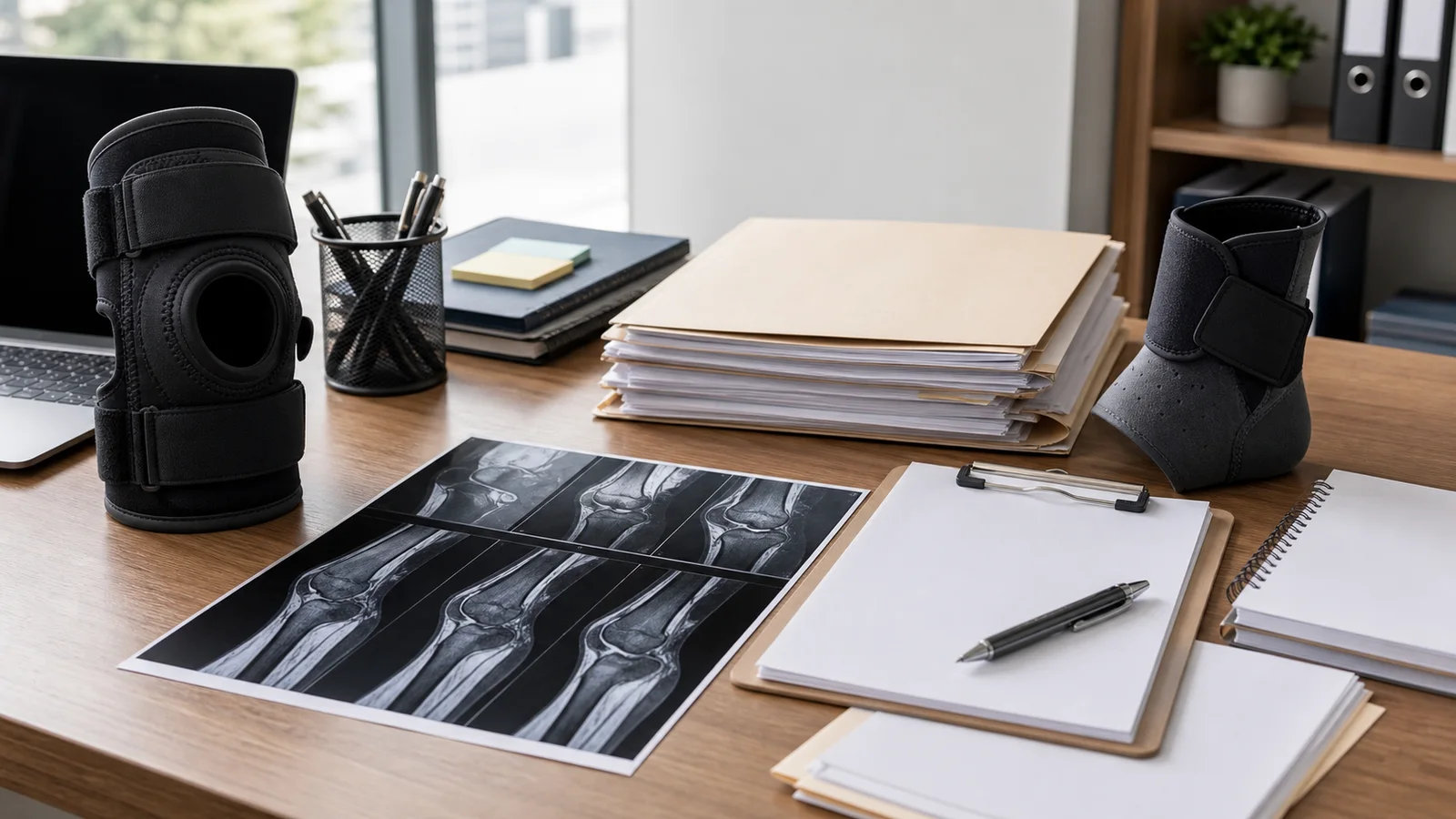
Investigations for ankle replacement may include weight-bearing X-rays, CT, MRI, ultrasound or operation records identifying the actual joint, fracture, tendon, ligament, cartilage, prosthesis or nerve condition and repeat goniometer measurements, stability tests, alignment findings and comparison with the unaffected side where that comparison is valid. Each result should answer a defined clinical question and be read with the examination, diagnosis and history.
- Orthopaedic, rehabilitation and physiotherapy records showing whether the condition has reached maximum medical improvement.
- Certificates of capacity and duties evidence about walking, standing, stairs, kneeling, squatting, driving, lifting and uneven ground. These explain claim impact but do not alter the WPI calculation.
How WPI is assessed for this body part
For ankle replacement, NSW Guidelines Chapter 3 applies AMA5 Chapter 17 subject to NSW corrections. The most specific valid method is used, and where more than one valid method applies the highest valid evaluation is generally selected unless Table 17-2 permits a combination.
If ROM is valid for ankle replacement, values in different planes of the same joint are added. Regional values in the same limb are expressed in the same unit and combined before conversion to WPI.
For ankle replacement, ankle dorsiflexion brings the toes towards the shin; plantarflexion points the foot down; inversion and eversion turn the sole inward and outward. Hindfoot alignment and true ankylosis use separate methods from ordinary movement loss.
Arthritis in an assessment of ankle replacement requires radiologically measured cartilage loss. For a knee, only the most impaired compartment is used. Arthritis cannot be combined with gait, atrophy, strength or ROM for the same loss.
For ankle replacement, gait remains a last-resort standalone method. Atrophy, manual muscle testing, peripheral nerve impairment and gait can duplicate strength loss and cannot be stacked. A diagnosis-based estimate is combined only where Table 17-2 permits it.
The calculation for ankle replacement cannot be changed because of activities of daily living under NSW paragraph 1.24. Functional descriptions help explain the evidence but are not an uplift or deduction.
Table and value examples
Ankle replacement score components
Pain 0-50; flexion 0/5/10/15; extension 0/5/10; limp 0/4/7/10; aid 0/1/3/5; distance 0/2/3/4/5; stairs 0/2/4/5; varus and valgus each deduct 0/10/15The stable clinical result is scored before the point total is converted. Surgery alone does not select a category.
Source: NSW Guidelines ankle replacement worksheet and Table 3.3
Total ankle replacement result
Good 85-100 points: 12% WPI (30% LEI); fair 50-84: 16% WPI (40% LEI); poor under 50: 20% WPI (50% LEI)Pain, walking, motion, limp, aids, stairs and alignment all contribute to the score.
Source: NSW Guidelines Table 3.3
Worked assessment illustrations
These examples paraphrase the assessment reasoning in the source material. They explain method only and are not predicted outcomes.
Illustration 1
Ankle replacement score and result category
Assumed facts: Assume the completed NSW worksheet totals 72 points after pain, motion, limp, walking aid, distance, stairs and any varus or valgus deductions are recorded.
Method: The point total is compared with NSW Table 3.3. A score from 50 to 84 is a fair result.
Illustrative outcome: The fair ankle replacement row is 16% WPI (40% LEI). The operation itself does not create that value; the stable post-operative score does. This is an illustration only.
Source: NSW Guidelines ankle replacement worksheet and Table 3.3
What usually does not increase WPI
An ankle prosthesis or continuing pain does not by itself choose the good, fair or poor category.
Pain, tenderness, swelling or difficulty walking does not create a percentage without a valid lower-limb method.
A scan label, surgery name or recommendation for surgery is not a fixed WPI result.
Work restrictions, weekly payments and inability to resume the pre-injury job are important claim issues but are not themselves impairment measurements.
Activities of daily living cannot be used to increase or reduce the calculated lower-extremity rating.
Evidence checklist
The records for ankle replacement should include the accepted injury description, date and any insurer decision limiting the body part or diagnosis and imaging and operation reports, including the relevant side, level, compartment and procedure. They are most useful when the diagnosis, examination and practical restrictions are consistent.
- Repeat movement, stability, alignment, circumference, limb-length or neurological measurements required by the selected method.
- A calculation worksheet identifying the table, regional unit, permitted combinations, conversion and rounding.
How this injury commonly happens at work
Work-related ankle replacement can arise through a severe ankle fracture or dislocation and post-traumatic arthritis after an accepted ankle injury. The chronology should identify the actual task or event and when symptoms or function changed.
Work-related ankle replacement can arise through work aggravation of accepted ankle pathology leading to replacement where medically supported. The chronology should record the actual task or event and the point at which symptoms or function changed.
Common insurer disputes
For ankle replacement, an insurer may dispute whether replacement relates to the accepted injury and whether the result is properly classified as good, fair or poor. The written decision should be answered with evidence directed to those reasons.
Further disputes about ankle replacement may concern whether symptoms have stabilised and whether walking, stairs, uneven-ground or driving duties are sustainable. The decision notice should identify which issue is relied on and the evidence said to support it.
Treatment and surgery issues
Depending on the diagnosis and treating opinion, management of ankle replacement may involve orthopaedic monitoring, physiotherapy and gait rehabilitation where supported. The request should explain the expected functional benefit and its connection to the accepted injury.
Weekly payments and work capacity
Capacity evidence for ankle replacement should address standing, walking, stairs, kneeling, squatting, driving and load carrying and safe duties that avoid unsafe mobility demands. Proposed duties must be sustainable for the proposed hours, not merely possible once.
For ankle replacement, capacity evidence should address travel to work and medication effects where relevant and weekly payment decisions where partial capacity is overstated. The question is whether those activities can be performed safely, reliably and for the proposed hours—not whether a task can be attempted once.
How NSW Work Injury Claim can help
For ankle replacement, a claim review can help to clarify diagnosis and mechanism of injury and compare work duties with medical restrictions. The purpose is to identify the precise decision and the evidence needed for the next available step, not to promise an outcome.
For ankle replacement, a claim review can help to respond to treatment or work capacity disputes and prepare WPI evidence when the condition becomes stable. The purpose is to identify the precise decision and the evidence needed for the next available step, not to promise an outcome.
Common questions about ankle replacement claims
How can work cause or aggravate ankle replacement?
For ankle replacement, the relevant work history may include a severe ankle fracture or dislocation, post-traumatic arthritis after an accepted ankle injury, and work aggravation of accepted ankle pathology leading to replacement where medically supported. A claim still depends on the actual chronology and medical evidence. The records should identify what changed, when symptoms began or worsened, and how the diagnosed condition affects the worker's duties.
How is WPI assessed for ankle replacement?
For ankle replacement, NSW Guidelines Chapter 3 applies AMA5 Chapter 17 subject to NSW corrections. The most specific valid method is used, and where more than one valid method applies the highest valid evaluation is generally selected unless Table 17-2 permits a combination. The completed worksheet produces a point total. NSW Table 3.3 then classifies 85-100 as good, 50-84 as fair and below 50 as poor. The assessor must apply the NSW Guidelines to the accepted, stable condition; the diagnosis or an operation does not by itself determine a percentage.
Which records are most useful for an ankle replacement assessment?
An ankle replacement assessment commonly needs the accepted injury description, date and any insurer decision limiting the body part or diagnosis, imaging and operation reports, including the relevant side, level, compartment and procedure, repeat movement, stability, alignment, circumference, limb-length or neurological measurements required by the selected method, and a calculation worksheet identifying the table, regional unit, permitted combinations, conversion and rounding. Those records are most useful when they describe the same diagnosis, examination findings, treatment history and practical work restrictions.
What does an insurer commonly dispute about ankle replacement?
For ankle replacement, common issues include whether replacement relates to the accepted injury, whether the result is properly classified as good, fair or poor, and whether symptoms have stabilised. The response should address the insurer's stated reason with the relevant chronology, clinical findings, investigations and duties evidence rather than relying on the diagnosis alone.
How can ankle replacement affect weekly payments and suitable duties?
Capacity evidence for ankle replacement may need to address standing, walking, stairs, kneeling, squatting, driving and load carrying, safe duties that avoid unsafe mobility demands, and travel to work and medication effects where relevant. A certificate should describe what the worker can do safely and sustainably. Proposed duties should then be checked against those restrictions and the real demands of the job.
Does ankle replacement automatically receive a fixed WPI percentage?
No. For ankle replacement, one verified example is ankle replacement score components: Pain 0-50; flexion 0/5/10/15; extension 0/5/10; limp 0/4/7/10; aid 0/1/3/5; distance 0/2/3/4/5; stairs 0/2/4/5; varus and valgus each deduct 0/10/15, under NSW Guidelines ankle replacement worksheet and Table 3.3. That value applies only when its stated criteria are met. An ankle prosthesis or continuing pain does not by itself choose the good, fair or poor category.
Request a calm claim position review
If you have received an insurer decision or you are unsure how your injury evidence fits together, we can help you identify the issue, organise the documents and consider the next step. Where ILARS funding is approved, eligible legal costs and necessary disbursements may be covered.